
Knee pain is one of the most common complaints we see at our orthopaedic practice in Singapore.
The first step to effective treatment is a clear diagnosis. Your knee is a complex hinge joint, and the pain you feel is a symptom, not the root problem. Causes of knee pain can range from a simple muscle strain to a complex ligament tear or the onset of chronic arthritis.
Knee pain can range from a minor ache to a ‘red flag’ warning.
Understand when you need to seek immediate medical attention (A&E), when to see a GP, and the risks of ignoring persistent pain.
Not all knee pain requires a trip to the Accident & Emergency department. However, certain “red flag” symptoms warrant immediate medical attention to prevent further damage.
Go to A&E immediately if you experience:
Book an appointment with your GP if your pain:
A “wait-and-see” approach can be detrimental. When you have persistent knee pain, your body naturally changes how you move to avoid discomfort. This is called compensatory movement. You might develop a limp, which in turn places new stress on your other knee, your hips, and your lower back, leading to a cascade of new pain points.
Furthermore, ignoring an underlying mechanical issue, like a small meniscus tear, can cause it to worsen. The tear can become larger, or the unstable joint can lead to premature “wear and tear” on your cartilage, accelerating the onset of osteoarthritis. A minor, treatable issue can become a complex surgical one if left unaddressed.
It can be difficult for a patient to pinpoint the source of the pain, but here are some general clues:
From overuse injuries seen at local parks to chronic conditions like osteoarthritis, we break down the four most common categories of knee pain causes treated by specialists in Singapore.
These injuries happen suddenly, often during sports or exercise.
These conditions develop over time.
These issues relate to the structure and movement of the knee.
While less common, other factors can contribute. A Vitamin D deficiency, for example, is known to cause bone and muscle pain, which can be felt as a dull ache in the joints. While stress does not directly cause arthritis, chronic stress can increase your body’s inflammation levels and heighten your perception of pain, making any existing knee condition feel much worse.
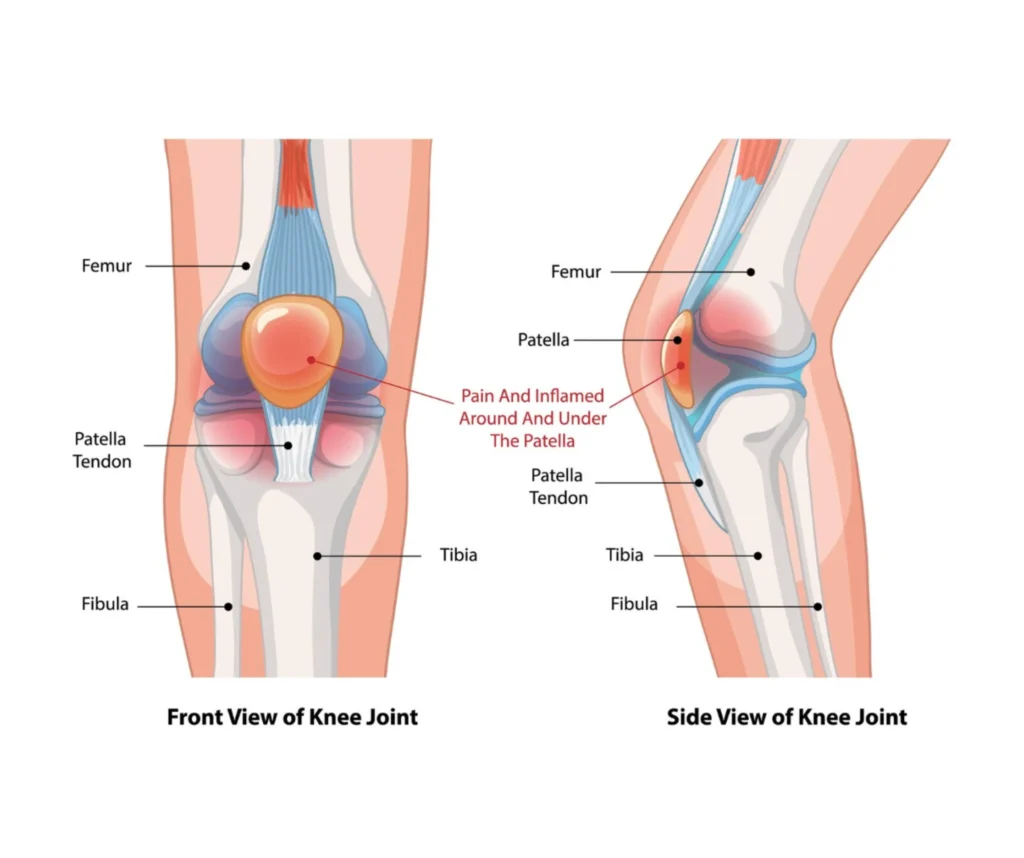
Unsure if you need a GP, a physio, or an orthopaedic specialist? The path from initial consultation to advanced diagnosis is clearer when you know that persistent pain or mechanical issues (like locking) are key indicators to see a knee specialist in Singapore.
Your GP can assess your pain, provide initial pain relief, and order basic X-rays.
Most importantly, they can provide you with a referral to a specialist, which is necessary to receive subsidised rates at a public hospital.
If your pain is muscular or seems related to overuse, a physiotherapist is an excellent choice.
They are experts in movement and can treat pain through targeted exercises, stretches, and manual therapy.
This is the expert for definitive diagnosis and treatment of structural problems like ligament tears, meniscus injuries, and moderate-to-severe osteoarthritis.
You can see a specialist directly at a private clinic.
At our practice, a diagnosis begins with a conversation and a physical exam. We will test your knee’s range of motion, stability, and strength. Based on this clinical exam, we may order imaging to confirm the diagnosis
This is the first-line imaging. It shows bones clearly and is excellent for diagnosing fractures and assessing the joint space narrowing seen in osteoarthritis.
This can be a useful and quick in-clinic tool to examine tendons, check for fluid collections (cysts), and guide injections precisely to the right spot.
This is the best test for looking at soft tissues. An MRI provides a detailed, 3D view of your ligaments (like the ACL), meniscus, and cartilage, allowing us to spot tears and damage that X-rays miss.
Treatment isn’t one-size-fits-all.
Learn the difference between immediate at-home relief and the long-term medical solutions available to fix the underlying problem.
This is one of our most-asked questions. The answer depends on the type of pain.

When at-home care isn’t enough, we have a range of effective medical treatments:
Getting a diagnosis in the private system involves a few initial costs.
Specialist Consultation
An initial consultation with an orthopaedic specialist typically ranges from $150 to $250.
X-Ray
This is the first-line imaging test and is very affordable, usually costing between $80 and $150.
MRI Scan
If the specialist needs to see the soft tissues in high detail, an MRI may be ordered. This is more expensive, often ranging from $1,000 to $2,000 per joint.
In Singapore, knee treatment costs vary depending on whether care is non-surgical or surgical, and whether it is done in a private or subsidised setting.
Injections
Common options include corticosteroid, hyaluronic acid and PRP. In private clinics, corticosteroid injections typically cost around $500–$800 per knee.
Hyaluronic acid injections are usually $1,000–$1,800 per knee, while PRP injections range from $900 to $2,200 per knee, depending on the preparation and whether imaging guidance is used.
More advanced regenerative injections can cost $4,000 and above per knee.
Surgery
Minimally invasive keyhole procedures such as knee arthroscopy generally cost $6,000–$10,000+ in private hospitals.
Partial knee replacement typically ranges from $25,000–$45,000, while a total knee replacement in a private hospital usually costs $35,000–$50,000 or more.
Subsidised public hospital options are significantly lower but may involve longer waiting times.
Final out-of-pocket costs depend on hospital choice, surgeon fees, implants, length of stay, and how much can be offset by MediSave, MediShield Life or integrated insurance plans.
For more costly procedures like surgery, your Singapore healthcare financing plans are crucial.
Medisave
Medisave can be used to pay for hospitalisation and approved surgical procedures, up to specific withdrawal limits. For example, a complex knee replacement is claimable up to a certain amount from the Table of Surgical Procedures. Some outpatient treatments, like viscosupplementation, are also claimable up to $450 per year.
MediShield Life
This is a basic health insurance plan that helps pay for large hospital bills and selected costly outpatient treatments.
Integrated Shield Plans (IPs)
If you have an IP from a private insurer, it works on top of MediShield Life. These plans are what cover the bulk of the cost if you choose to be treated in a private hospital or an A/B1 ward in a public hospital. It is essential to check your specific plan for coverage, deductibles, and any co-payment required.
Dr Yong Ren brings extensive expertise to the field of minimally invasive orthopaedic procedures. His background includes specialist training in Switzerland, focusing on complex orthopaedic trauma and reconstruction, underscoring his capability in handling simple to highly complex joint issues.
Choosing us means you benefit from:
Dr Yong Ren’s practice prioritises the least invasive techniques, leading to smaller scars, less post-operative pain, and faster return to function.
We believe in treating the whole patient, not just the injury. This includes a full, multi-modal pathway from non-operative treatments (like physical therapy and injections) to the latest surgical techniques.
We provide clear, locally-relevant guidance on everything from the procedure itself to the intricacies of Medisave claimability and insurance processing in Singapore.
If you have been living with persistent pain, or if you have questions about your orthopaedic condition and wish to explore personalised, advanced treatment options, we encourage you to consult with Dr Yong Ren.
Take the first step toward a pain-free life with a $150 Knee Pain Consultation & X-ray.